Empowerment

Empowerment
Showing posts with label Feminism. Show all posts

Monday, April 4, 2016

My Message

So I have been doing some major reflecting lately. I have been thinking about the fact that I don't want to be famous and well known, but I want my message to be known. I want my voice to be heard, my message to be shared.


I want to empower women, not to rule the world, but to live a life that is true to themselves. A life that allows them to take their unique set of skills, talents, and passions and do something remarkable. I want women to empower each other. I want to show women that we can do so much more when we work together, when we lift each other up instead of constantly beating each other down.

We live in a world where women are constantly pitted against each other. A world where one of the greatest insults is to be told that you do something like a girl. A world where we are told that we must reach certain standards or we have failed as women. A world where those standards are unattainable. A world where women who are claimed to have reached those standards far too often allow the world to believe they have, even when they haven't. A world that tells us that a man who has decided he is a woman is a better woman than all of the rest of us. A world that has beat us down for far too long.

This world does not show us what can happen when women come together and make miracles happen. A world that does not show us that every single woman has something special and unique to offer the world. That the standards the world has set for us mean nothing. One woman cannot be everything in the world, but she can change her world.

Every woman has her specific set of gifts, talents, and passions for a reason, and that reason is to changer her world. For some women that world his her house and family. For other women that world is a classroom. Other women it is an operating room, a business, a school, a town, a state, or a country. And for some women that world really just may be the world. NO matter what world you are changing it is important. YOU are important. You have a reason. You have a purpose and the world would not be the same without you in it.

Friday, June 12, 2015

Great Buzzfeed Post!

In a search for a subject for my next post I stumbled across a post from Buzzfeed. Usually Buzzfeed, in my experience, merely has entertaining articles, not necessarily educational/historical ones. The article, 100 Inspiring Women, lists 100 women who were the first to do something throughout history. There is a timeline laid out with these women and their accomplishments. Take a look!

Friday, May 8, 2015

First Woman Doctor in Britain Was A... Man?

Did that title confuse you a little? Hopefully it got your attention!
Dr. James Barry, a British physician was a man of great renown. Known for his ill temper and great medical expertise, the man who had become Inspector General of Military Hospitals kept a sensitive secret throughout his medical career. This secret would not become exposed until after his death and burial, something that he had tried to prevent from happening even then.


Margaret Ann Bulkley was born in County Cork, Ireland in the 1790's. After her father, Jeremiah Bulkley, a greengrocer, was arrested for debt, Margaret and her mother turned to James Barry, Margaret's maternal uncle, for support. James Barry, a well known artist, was a liberal and forward thinker for his time. He was a member of a set who strongly advocated women's rights and education. After his Barry's death he left a large amount of money to Margaret and her mother, while his group of friends gladly took them under their care and support.

The Bulkley women moved to London where Margaret began taking lessons from Edward Fryer, a physician. Margaret was a quite capable student, and before long a rather elaborate and ambitious plan began to take shape. It was decided that Margaret would decide herself as a young man and enter university to train as a doctor, as women were not permitted to study at the university.

In 1809 the new and "resurrected" James Barry sailed from London to Edinburgh with Mrs. Buckley to establish themselves as aunt and nephew. Margaret Ann Bulkley was no longer. Margaret/James enrolled at the university as a medical student and the mother and daughter were soon well established in the area as aunt and nephew.


Thanks to an overcoat to disguise her figure and a tweak to her age to explain her higher voice and smooth chin, Margaret, now James, flew through medical school and three years later returned to London as an apprentice surgeon for six months at St. Thomas' Hospital.

In 1813 Margaret joined the army, and three years later was posted to Cape of Good Hope in South Africa. While in South Africa she hired a black manservant who would serve her for half a century, during which he would lay out six towels every day for her to use to broaden her shoulders and hide her curves.

Dr. Barry was known to be a bit of a "prickly" character, highly defensive of his honor, and very outspoken about his beliefs. When one realizes that Dr. Barry was actually a woman, I feel that you gain a better understanding as to why "he" behaved the way he did.

Apart from Barry's personality, Dr. James Barry became a surgeon of great acclaim, being the first surgeon to successfully compete a Cesarean section in Africa, saving the life of both mother and child. Barry ardently fought for proper hygiene practices, radically changed the treatment of leprosy and tropical diseases, and raged against poor medical treatment.

Although Barry's personal life and behavior had many flaws, the medical achievements reached by Dr. James Barry, a woman, were amazing for anyone of that time period. Even though she had to live her life as a man, her achievements show that, given the chance, women were just as capable as men.

While Margaret did not become the first female doctor in Britain as a woman, but as a man, she was still the first female doctor in Britain.

Sunday, April 26, 2015

"Women are Unfit to Fly"

So recently I substituted for a second grade class. For reading we read this short true story about a woman I had never heard of before. I have been meaning to write about her, but for some reason just have not gotten around to it. I can honestly say there is no good reason as to why I have not posted in almost two weeks, I just have not. I have wanted to write about her, so I figured I should work on it today, since I had my computer out anyways!


Ruth Bancroft Law was born May 21, 1887 in Lynn, Massachusetts. Her parents were Sarah Bancroft Breed and Frederick Henry Law. She had at least one older brother, Rodman, who eventually went on to become one of the first stuntmen. There is not much information about Ruth's childhood, but there is evidence that she was a tomboy growing up and was adventurous. When Ruth was still young she fell in love with flying and airplanes. She purchased her first airplane from Orville Wright. While Wright willingly sold her the plane he refused to teach her how to fly it, claiming that women were unfit to fly.


In the summer of 1912 she started flying lessons at Burgess Flying School and took her first flight a month later in July. The next month she took her first solo flight and in November 1912 she received her pilot's license. Her adventurous streak rolled over into her aviation career. Ruth became a competitive daredevil and was making as much as $9,000 a week doing exhibitions. After three years of flying she announced that she would be performing a loop the loop for her audience. No woman had yet completed a loop the loop. Her husband, who apparently was always nervous when she performed, was against her completing this daring feat. However, Ruth was quite capable and not only successfully completed a single loop the loop, but did two loops!! This made her the first woman to complete the loop the loop. That same year, 1915, she also became the first woman to fly at night.

The next year would prove to be another record breaking year for Ruth. One was an altitude competition, where after competing multiple times and being judged unfairly she insisted that she be judged the same as the men and at Sheepshead Bay in New York set a new record of 11, 200 feet. However, her greatest endeavor was a cross country distance record, which is is the story I read about in the class I substituted for. The former record was 462 miles, she completed a flight from Chicago to New York state, a distance of 590 miles. . The next day she flew to New York City, but had to make an emergency landing while flying over Manhattan as her engine cut out due to lack of fuel. She made this flight in November of 1916, in freezing cold weather. She wore multiple layers, with a skirt over it all, as she was a "proper lady". Crowds celebrated her record breaking flight and President Woodrow Wilson toasted her at a dinner held in her honor in December of 1916.

When the United States entered World War I the following year Ruth promptly enlisted as a pilot. She learned that she would not be allowed to fly in combat and wrote an article for the "Air Travel" magazine entitled "Let Women Fly". She was informed that she would not be allowed to fly, but would receive a uniform and could help with recruiting. She was the first woman to wear a United States Marine NCO uniform and continued to do exhibitions to raise money for the Red Cross.

After the war Ruth continued flying in exhibitions and breaking records. She once again broke an altitude record by reaching a height of over 14,500 feet in 1919. Three years later Ruth announced her retirement from flying. She stated that she had been in the limelight long enough and now it was her husband's turn. She explained by saying, "Why? Because I'm a normal woman and want a home, a baby, and everything else that goes with married life. Why, I've been married almost ten years to Charlie Oliver, the man who has managed my exhibitions, and scarcely anyone knew who he was. And the poor boy was so worried about me all that time that every time I went up he lost a pound. It was a matter of choosing between love and profession. Of course, I'm just crazy about flying, but one's husband is more important!"  

After her retirement Charlie and Ruth moved to California where they lived for almost fifty years. Ruth died on the first of December, 1970 at the age of 83.

Sunday, April 5, 2015

Historical Women on United States Currency

Ever since I heard about the Women on 20's campaign last week, the idea has been on my mind. I have read several articles, as well as some of the comments on them, about women on currency. There is obviously a wide range of opinions about whether or not women should be on currency. For some reason some people seem to think that individuals who are featured on currency must be white males. Or if they are not, they must have done something in their life like cure cancer, end world hunger, AND end poverty. Simply doing one of those things would not be enough to get *gasp* a woman on U.S. currency. A woman?? INCONCEIVABLE!

Now, I have great respect for the men on our United States currency, were they perfect? Most definitely not, but each of them did things worthy of respect, some more than others, and they each helped shape the United States in one way or another. They played a vital part in shaping our country into one that is the "land of the free and the home of the brave", but sometimes it feels like there is an addendum to that *as long as you are a wealthy white male*. Should they be removed from currency and simply forgotten? No, but perhaps it is time for new heroes on our currency.


What is interesting is that if you look back 120 years ago, before women in the United States even had the right to vote, you can find Martha Washington, wife of President George Washington on the $1 bill. That's right folks, the United States actually put a woman on currency before women could vote! Even more "shocking" is that 20 years before Martha Washington showed up on the $1 bill another woman was featured on the $10 and $20 bills. And guess what, she was not related to a president in any way, in fact she was not even a white woman. Pocahontas was once upon a time, featured on United States currency.


I wonder if some people see this movement as saying that women are better than men, that those who are pushing for this want to "kick" off all the men on United States currency and replace them with women. For me, personally, it is definitely not about that. It is about recognizing that there should be equality for men and women, that women have done amazing wonderful things that have benefited our country. That women who have truly changed the world deserve to be recognized, just as men who have changed the world have been. It is showing our society that we recognize that men are not better than women and that women are not better than women. That society benefits from an equal partnership between men and women, and that this is just a step in that direction.

Thursday, April 2, 2015

Are You A Feminist?

My 19 year old brother recently asked me after a conversation we had, "What are you one of those FEMINISTS?" "No!" I instantly replied, but immediately thought, "Yes!... No, well not THAT kind of feminist."
Do you know the kind I mean? Those "feminists" who have been coined femi-nazis. The man hating, burn your bras, I can do everything better than a man, men should be locked up and only used for breeding purposes, feminists. I feel like that is the sort of feminism we now associate with the word. It has gotten a whole new meaning and that meaning is not something I identify with. The definition I identify with is that straight out of the dictionary.

Feminism: the advocacy of women's rights on the grounds of political, social, and economic equality to men.

I identify with equal opportunity for men and women. I identify with equal freedom for men and women, the idea that women are just as capable as men. The idea that men and women are compatible and should work together. I identify with the fact that women are powerful, that sometimes they have gifts and abilities that men do not. How many quotes are there out there about this? "If you educate a man you educate an individual, but if you educate a woman you educate a family/nation/generation." Or one of my favorites:


I do not identify with the man bashing, raising women to trample on top of men "feminism". I will admit I have had my moments of saying things such as, "I hate men. Guys are dumb." etc. This is usually during a frustrated rant with friends about some sort of dating/men drama of mine or theirs. I have tried to be a lot better over the past few years about trying to correct myself when I saw things like this. I don't hate MEN, sometimes I hate the dating, guy/girl drama, miscommunication stuff, but some of the best people I know are men. I've got a whole family full of great guys. Are they flawless? No, but neither are the women. (Although, to tell you the truth I've got a few family members who I swear come pretty dang close.)
So, am I a feminist? Yes, but a by the dictionary definition of feminist. If you were to look at the pages I "like" on Facebook, you would see, (amongst the German Shepherd kennels, dog training, animal rescue, Idaho, horse barns, beautiful world, etc. pages) several pages about strong women. Pages like A Mighty GirlFit is a Feminist IssueGirls Are Not For Sale, etc. So, yes I am a Feminist. 

With that being said, there will definitely be some posts on here that are more strictly about feminism, and not just featuring powerful women. After all, isn't sharing powerful women who broke barriers, defied the odds, and proved that she could do anything feminism? 

Seven Continents Visited- Where Do I Go From Here?


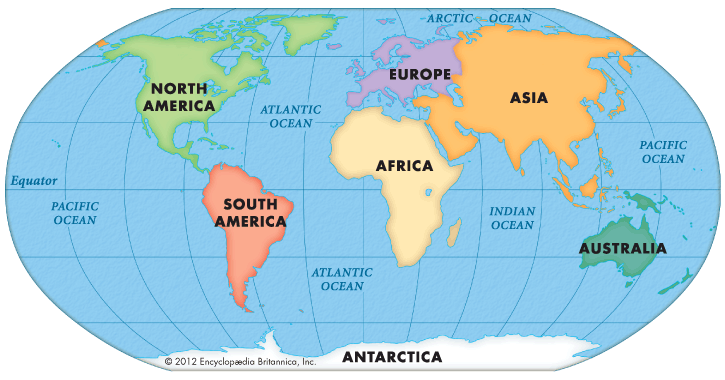
With my post yesterday on the first female scientists in Antarctica I wrapped up my project of featuring a woman from every continent. It was a project I enjoyed and learned a lot from. For me it was a great introduction into the world and the amazing women that inhabit it. It has been a great experience for me to see viewers from all over the world, I hope that continues and grows. Like I have stated before my eventual goal is to feature women that I know, and then eventually my dream is that readers will contact me about women they want to see featured. I would love to be able to highlight women across the world who have been nominated by people in their life. I know it may take awhile to actually get to that point, but it is where I want to end up. That means I need a wide audience and people willing to share what they read and share my mission. Thanks for joining me on this journey so far, and I hope you will stick with me as I start my next project.

Wednesday, April 1, 2015

First Female Scientists in Antarctica

It seems that many people agreed with Darlington when she stated that she did not think women belonged in Antarctica. It was long believed, by both sexes, that the female sex, the "weaker" of the two, would not be able to endure the rough Antarctic continent. Antarctica became, in many ways, the last, great "boys club". It was as if Antarctica was a giant tree house with an even bigger "NO GIRLS ALLOWED" hung up above it. Sure, the occasional "girl" got it, due to special circumstances such as being married to a member of an expedition, but they were not allowed in based on their own merits. In fact, the United States Navy REFUSED to transport women to Antarctica. Even if American scientists, who happened to be female, were able to somehow get to Antarctica, they would not be allowed to work on the ice, as the National Science Foundation (NSF) forbade women from working on the ice.

*Now, for the past several days I have been trying to figure out for sure who the first woman was to actually be allowed on Antarctica as a scientist. I keep finding articles and such that state who the first American female scientist, or Australian female scientist, etc. but not just the flat out first female scientist.*

It wasn't until the 1950's when Marie V. Klenova, a Russian marine geologist, was a part of an oceanographic team that was mapping uncharted portions of the continent that we see the first woman as an official part of scientific team in Antarctica. Russian women had sailed aboard whaling ships for years in the area, which made it a bit easier for her to break into the Antarctic scientific world. Klenova's work was part of the first atlas of Antarctica which the Soviet Union published.

Besides Marie Klenova, women did not do much work on the ice in the 40's and 50's as many countries, like the United States, did not allow women on the ice. In fact, it was not until the very end of the 1960's, after the Women's Liberation Movement, that we begin to see women actively participating in scientific endeavors on the Antarctic continent. The first woman to become a member of the United States Antarctic Research Program was Christine Muller-Schwarze, a psychologist with her Ph.D. from Utah State University. Alongside her scientist husband she studied the behavior of penguins on the Antarctic.

After Muller-Schwarze was able to break into the scene, the floodgates opened, and more women came to work on the frozen continent. Just a few weeks after the study of penguin behavior started, an all women team from Ohio State University arrived, headed by Lois Jones. Among the four women team was a 19 year old undergraduate student, Terry Tickhill Terrell, who joined the team after despairing at the idea of spending her entire college career inside of a chemistry lab.


The team from OSU, Kay Lindsay, Terry Tickhill Terrell, Lois Jones, and Eilenn McSaveney. 

Terry Terrell, who had never traveled more than 300 miles from her home, was now traveling to the bottom of the world, not quite knowing all of the barriers that had always stood between women and the place she was now headed to. There was a concern, or maybe a belief, that these women would not be able to make it down in the Antarctic. Their every move was watched, would they mess up? Would they come off weak, needy, inept? Knowing that they were under extreme scrutiny, the women kept to themselves, taking care of every issue they could on their own, and did what they came to do.


After awhile everyone came to accept that these women were there, and not only were they there, but they were doing their jobs quite well. Eventually the Navy decided to "cash in" on this novelty of women on their continent. Up to this point no woman had ever stepped foot on the South Pole. The Navy took the women down to the South Pole and organized the moment of the first woman to step foot on the very bottom of the Earth. The only problem was, who would be first? Rear Admiral D.F. Welch who was the commander of the naval forces in Antarctica at the time decided with Solomon like wisdom that the solution was for all six women to jump off the back of the plane at the same time, so they could all be the first woman to step foot on the South Pole. 


November 12, 1969 LtR Pam Young, Jean Pearson, Terry Tickhill Terell, Lois Jones, Eileen McSaveney, and Kay Lindsay.

Woman had arrived at the South Pole. It was a momentous occasion and was an event that was a long time coming. While women are still not in equal number as men on the Antarctic continent, they are at least now represented, and more so than they have been in past years. 


Tuesday, March 31, 2015

First Women in Antarctica

The history of the discovery and exploration of Antarctica is a long one. From rumors of the continent, to the near discovery in the 1770's, to the first people to finally reach the South Pole in 1911, it stretches across centuries. While the first man stepped foot in 1911, the first woman would not arrive until more than two decades later, with Caroline Mikkelsen, the wife of a Norwegian whaling captain being the first woman to step foot on Antarctica in 1935. Her excursion to Antarctica was brief, but it was the first of its kind. It would be more than a decade until Antarctica would see another woman.

Caroline Mikkelsen
In 1947 we see the first women to winter in Antarctica, with the arrival of two women traveling with their husbands who were members of the Ronne Antarctic Research Expedition. Edith "Jackie" Ronne and Jennie Darlington, two women who originally planned on only journeying with their husbands as far as Valparasio, Chile, the last stop before reaching Antarctica, wound up at the last minute continuing with the Expedition to Antarctica. According to an obituary in the Washington Post, Ronne actually never planned on going with her husband at all, she traveled to Beaumont, Texas to see him off, but planned on returning home after that. The obituary states, "She packed little more than a good suit, a good dress, nylon stockings and high heels for the trip." However, her husband persuaded her to go with him, and she gave in, joining him for the journey, from Panama to Chile.
Jennie and Edith
Jackie making coffee in the hut.
*These two pictures came from The Antarctic Book of Cooking and Cleaning


Once Jackie was convinced into going to Antarctica with her husband, she wanted another woman to go with her. Jennie Darlington, new wife of the chief pilot of the Expidition, Harry Darlington, was to be the second woman. Ronne was the first American woman to step foot onto Antarctica, and Ronne and Darlington became the first women ever to spend the winter in Antarctica. After they left Antarctica Darlington stated, "Taking everything into consideration, I do not think women belong in Antarctica." Ronne's opinion was, "I will never, never go back to the Antarctic." While Darlington stuck with her opinion, Ronne returned thrice more to the Antarctic in her future years. 

These three women were the first women to ever step foot on Antarctica. Jackie Ronne was the first woman to assist the members of an Expedition, although she was not technically a member of the Expedition, she did serve as their recorder-historian. 


Monday, March 30, 2015

Lawyer, Professor, Wife, Mother, and Political Activist

As I have been looking for the woman to feature for South America I have come across a lot of interesting information and a few potential future women. It has been a bit difficult gathering a ton of useful information on this woman, simply because a lot of it is in Spanish and well, I don't speak Spanish! With that being said, there might not be as much information about this woman as I would like, but I was struck by the little information about her that I could gather and wanted to share. She does break my preference of featuring women from the past, as she is still alive and actively engaged in activities.


Laura Albornoz was born March 27, 1968 in Chile, a country where women did not gain the right to vote until 1952, less than two decades before she was born. In a country that in many ways is ahead of the countries near it, but in other ways, equality and women's rights is far behind. 

From a young age Laura was involved in the political world, participating in the Federation of Secondary Students. Laura received her doctorate in Civil Law from the University of Seville in Spain, graduated cum laude. She has several degrees from Universities in both Spain in Chile.
From 2006-2009 Laura served as the Minister of Woman's Affairs under the first female Chilean President, Michelle Bachelet. Today Laura is Vice President of a major political party in Chile, a professor at a university, and a lawyer. She is also a wife and full time mother to two children.

While Laura carries an active role in the political and judicial world of Chile, she also still maintains the maternal roles that are so important in the Chilean culture. She does the grocery shopping, keeps the house clean, takes care of her children, and cooks dinner. According to a NPR interview she says that this keeps her busy in a way that men just don't understand. While other, male, ministers may have many responsibilities as well, those responsibilities don't extend into their home life as hers do. 

In South America, motherhood is an important part of feminism. In the Chilean women's movement, women have used their maternal responsibilities as a way to increase their say and involvement in the political sphere. I love the way that they are going about this, at least from the little bit I have seen. I feel like so many modern feminists almost downgrade mothers and a woman's role as a wife and mother, but here is a country of woman who say the opposite, who say that those roles and traits help make women more successful in the political world. I love that this is a woman who is doing it all, she has her career, but is still a mother, cooking, cleaning, etc. 

Sunday, March 29, 2015

Women on 20's


Today while scrolling through my Facebook feed I came across this post from A Mighty Girl. I had not heard ANYTHING about this movement and it really caught my attention. As I looked at the post and as I peruse the website I am struck by the fact that I have not ever given it much thought that the United States does not have any currency or coin in regular circulation that has a woman on the front. Yes there are the Susan B. Anthony pieces, but if you are anything like me those are in your coin collection and not spent. There was the Sacajawea gold dollars, but once again those were not mass circulated and you very rarely see them.

If you have ever seen coins and currency from other countries, many of them feature queens from their past or recent past, as well as important men. Somehow though, we seemed to have missed that ship. In the United States, you know land of the free, home of the brave, all of our regularly used coins and currency feature only men. Now, I have great respect for these men, and for a lot of the things they did. Were they perfect? No, but each one did some amazing things and played an important role in our history. That being said, there are many many MANY women throughout history who also did amazing things and played an important, albeit less heard about, role in our history.

With all that being said, how is it that I have never given it much thought that there are no women on our currency and coins? I really do not know for sure, but I do like this movement, and I am thinking that after I find my woman/women for South American and Antarctica I am going to feature the candidates for the Women on 20s.

Saturday, March 28, 2015

Australia's First Female Acting Professor

So, with that great website that I found I had all sorts of wonderful options for my featured woman from Australia. I will admit that I did not go through every single woman on the site, but I now have a lot of options for future posts!


Born on January 22, 1875 Georgina Sweet would become Australia's first female acting professor. She was born in Brunswick Australia to English born parents, George and Fanny Sweet. Georgina's father, George ran a pottery and tiling business and was a hobbyist geologist. He had what sounds to be a quite impressive fossil collection that can now be found at the Museum of Victoria. Georgina acted as a scientist when she was young and her father encouraged her interest in science. As she got older she had his encouragement to go into science as a career.

Georgina first attended Parkville Ladies' College and then received her Bachelor's of Science from the University of Melbourne in 1896. In 1898 she won the University of Melbourne's McBain Scholarship and completed her Master's of Science from the university. For about eleven years from 1896-1907 she taught various secondary schools in the area. During this time she also filled several positions at the university, she was a demonstrator as well as a lecturer in Biology. Much of her research was done in the Biology department under Professor Baldwin Spencer. She also did research in the zoology department of the university. In 1904 Georgina Sweet completed her Doctorate degree at the University of Melbourne.

Initially Georgina's work in zoology focused on the Australian native animals. Eventually she switched and started pursuing the parasites that Australian stock are infested by. It was because of her research in this area that in 1911 she won the David Syne research prize. Her work was widely published and she eventually became known as Australia's foremost parasitologist.

In 1915, after a death in the biology school she became the second in command for that school at the University of Melbourne. It was the next year during the absence of one of the professors, whose place she took, that she became Australia's first acting associate professor, and in a science field none the less!!

While Georgina said that she never felt downtrodden or oppressed being a woman in a "man's" field, she was an active supporter and fighter for women's rights. In fact, on June 3 1935 she was appointed Officer of the Order of the British Empire, because of her services in the women's rights movement.


I love the fact that this woman pursued an interest of hers, that at that time was not something woman were encouraged to do. Not only did she pursue it, but she took it all the way to a Doctorate degree and taught at a university in that subject! From what I have read she had a true passion for it, and was able to spread that passion to others. She donated a large amount of money to her university, and today there is a fellowship in her name at the University of Melbourne. Georgina died January 1, 1946. 

Thursday, March 26, 2015

Article-A Man's Perspective on Modesty and Boys Will Be Boys

I was just Facebook stalking one of my cousin's Facebook pages. I was realizing I haven't seen her very much the last few years and hadn't seen many things from her lately on Facebook. While I was looking over the last few months of her posts I found this article, A Man's Perspective on Modesty. I was interested on what it said, and it seemed like it came out about the same time that all of that hullabaloo was going around the internet about whether or not to wear yoga pants. So I clicked on it and read it. It is definitely from a college aged guy, so his analogies are a bit, well college aged guy like, but I love what he has to say. It is what I tend to say.


I don't want to get into the whole modesty issue right now, as far as what is and isn't modest, whether you should or shouldn't dress modestly. Whenever the issue comes up, whatever side you are on, I tend to find myself most passionate about what is said about men in the whole discussion. So often men are made out to be these uncontrollable creatures who are unable to contain themselves. They are almost somehow subhuman in that they are not able to control their urges and desires. This sometimes morphs into the "boys will be boys" statement that we hear. It goes something like this, "well you can't blame him, boys will be boys" or, "What did you expect, boys will be boys." It is as though anything a male does that is harmful towards women could and should just be waved away, because after all, boys will be boys.

While this mindset is not used in every case, in every location, all the time, it is an idea that is perpetuated even today. Yes, boys will be boys, but that is not an excuse or a pass for dangerous, illegal, or harmful behavior. We first start using this excuse/reasoning when they are young. Two boys wrestle, fight, etc. Well, boys will be boys. A little boy brings frogs, rocks, etc. into the house, while he, himself is covered in dirt. Boys will be boys. A little boy punches another child for taking his toys. Boys will be boys. While some of these instances are definitely not harmful and the saying is something to laugh about because it is true, others are not. I just found a great post about a mom with a son who hears this phrase and her reaction to it. Boys Will Be Boys.

Like the image says, "boys will be boys, ....doesn't have to mean raising a little cave man."


Wednesday, March 25, 2015

Powerful- What Does it Mean?

As I search for the next woman to highlight, either from Australia or South America, I run various Google searches hoping to stumble upon the right woman to feature next. I usually start out with a search of powerful women from that continent. Guess what sort of links pop up when I run this search? See for yourself. Someone who is powerful is someone who has influence in the business world. Someone who has money, or influence over those with money. While some of these women most definitely are wonderful role models, women who are powerful, self confident, and able, not all of them are. Some are not great role models, and definitely not the kind of woman I want to feature.


For whatever reasons, this is the type of women who are considered to be the most powerful. Like I have said before, this is not necessarily the type of woman I am looking for. 


Friday, March 20, 2015

The First Afrikaner Feminist?

Ready or not, here she is! So the past several days I have been doing various Google searches trying to find just the right woman to highlight for the African continent. During these searches I found several amazing women, some who were actually from a country in Africa, some who were born elsewhere and moved there. Some of these women were dead, most were still alive. However, none of them were quite what I was looking for.

Sometime either yesterday or the day before I stumbled across a journal that had been put online from a few different woman who had been in the concentration camps during the Boer War. These were interesting, but there was not quite what I wanted. (Really, I do not think I could tell you exactly who I was searching for, or what I wanted, but I felt like I had not found the right individual yet.) After finding these journals I decided to do a bit of digging around to see if I could find a woman who lived somewhere around that time period that felt right.

Concentration Camps during war (1899-1902).

Yesterday I came across a name and a short blip about a woman and it struck a nerve.

       "A single Afrikaans woman raised her voice against this ideology. She was Marie du Toit, the             sister of Prof. J.D. du Toit, popularly known as the Afrikaans poet Totius. In her book, Vrou en           feminist, of Iets oor die vrouevraagstuk, published in 1921, she objected against the                            recommendation of a committee headed by her brother that, on biblical grounds, women should          not be allowed to vote, neither in church nor in parliament."

I hadn't read much more than that, but I felt like here was a woman who was power. A woman who had stood up for something she believed in, against something she felt was wrong. The fact that she wrote a book going against something that her brother was backing, something that she objected to, was an idea that I just loved. 

I started digging around online, trying to find more information about this woman. I did not have a ton to go on, so I just searched for her name. Apparently there is/was an actress with the same name. I tried different search tactics to try and find more about her. 

Some back history to why Marie du Toit wrote her book and what was going on around her at that time. Several years prior to the publishing of her book, a monument, The Women's Monument was built in Bloemfontein. This monument was in recognition of the state and bravery of the Afrikaaner women. While this monument sounds like a great idea, no women were able to participate in the inauguration of monument, no women were interred there, and the suffering of the women was used to garner worldwide sympathy for the cause of the Boers. Actually, a man who allowed women to have a bake sale so that he could have funds to write a history of the woman, wrote the history to show that these women's souls "were too pure for politics, and that they had no intentions of becoming suffragettes like the women in Europe who worshipped the ideals of the French Revolution." 


Basically, at this time, in this country, women were applauded for show submission and being subservient to their husbands. Since their souls were too "pure and fragile" for much else, they were expected to stay at home and take care of the family. (Now, I am not saying that no woman should ever stay home and take care of their family, I think that this is something that is actually a noble calling, and not something to be looked down upon.) Women were not allowed any power, political, religious, etc. and were seen as not strong enough, smart enough, etc. to hold any power or position. 

Marie du Toit wrote her book in response and reaction to the decision made by the Reformed Church of South Africa in 1920, of which her brother had a part of, that stated women would not be permitted to vote about matters of the church. Apparently, this committed had found verses in the bible that they believed supported their decision to deny women the ability to vote in both state and church matters. Marie du Toit, however, debated that it was not Jesus nor nature that kept women held to private life, but rather men who did this. She, in fact, argued that it was a time when  those suffering from poverty and oppression needed the insight and intelligence of women to help. In addition to this she believed that women should be allowed equal access to education and pay. She stated that the restrictions placed on women and the subservience expected of them was unnatural, and her interpretation of the Bible was that Jesus sought for women to be human beings, free akin to men. It was not the right of men to choose whether or not women could vote and be involved in public and political life. She asked Afrikaaner women to stand up and stand together to get their rights and to not feel unworthy. She wanted women to moved out of the private life in their home, and to move into a world where they could hold political power and make a difference in the world.

As far as Marie du Toit's life, little can be found on the internet. She was born in 1880 and remained an unmarried school teacher until her death at 51 in 1931. She did have tuberculosis, and I am assuming that this is what she died of. At the time of the publishing of her book she was little known, with apparently no supporters. She was a lone voice in a time and a country where her views were much before their time. Even today in a world of feminism and a struggle for equality between men and women, she is a unheard of individual.


Monday, March 16, 2015

"Shrinking Woman"


I don't know the first time I saw this video, but I remember the way it impacted me, and the feeling it left me. I think in so many ways even the title perfectly captures what has happened to women over time. 

When she talks about how every question she asked in class started with the word sorry, I could complete relate to that. How many of us feel as if we are intruding, being obnoxious, interrupting, etc. when we have a question or something to add to a discussion? In a classroom where you are at to learn, why must one feel the need to apologize when they are asking a question, asking to LEARN something? This is not something to apologize for, and yet more often than not, it seems that women DO apologize. Perhaps they feel "sorry" for not understanding, or for interrupting, but, one has the right to be confused, to ask a question when they need clarification, it is not something to apologize for. 
Why must we feel the need to always use the word sorry? There is definitely a time and a place to use the word, but in so many ways it has become over used and in some ways has lost its meaning. 

Women have been shrinking for so very long, feeling the need to take up less space, to make room for others, not just men. It seems to be more of the norm for women to think that they are not a priority, that they need to make time, space, room, etc. for everyone else in their life, to appease others, sacrifice themselves, etc. What is the cause and purpose of this? Is the "shrinking woman" really benefiting ANYONE by "shrinking"? Is she doing good in the world by allowing others to "invade" her space and take over her life? I think the quote from Marianne Williamson best answers that.


Our greatest fear is not that we are inadequate,
but that we are powerful beyond measure.

It is our light, not our darkness that frightens us. 
We ask ourselves, Who am I to be brilliant,
gorgeous, handsome, talented, and fabulous?

Actually, who are you not to be?
You are a child of God.

Your playing small does not serve the world. 
There is nothing enlightened about shrinking
so that other people won't feel insecure around you.

We were born to make manifest the glory of God within us. 
It is not just in some; it is in everyone.

And, as we let our own light shine, we consciously give
other people permission to do the same.
As we are liberated from our fear,
our presence automatically liberates others.

This has long been one of my favorite quotes/poems. I wrote about it in another post. 

I think throughout history they have always been those women who realize that "shrinking" is not the best way to live and serve the world. One does need to be overpowering, domineering, thoughtless, or selfish and does not become those things by NOT shrinking. There is a balance between realizing your own worth and living your own life and helping others. Some women go too far one way or the other, but in my view shrinking is just as harmful as being thoughtless and selfish. "There is nothing enlightened about shrinking so that other people won't feel insecure around you."

Friday, March 13, 2015

Power vs. the Bikini

Have you ever seen this video? Jessica Rey talks about the evolution of the Bikini and goes into research that has gone into how women are viewed when wearing a bikini. Not only does she talk about the bikini, but also about modesty. Take a look.


There are so many different parts of this video that I just love/want to discuss. While there are definitely some interesting points in the beginning about historical bathing suits and policies on the beaches, I am going to skip that part. The part that first stood out to me, both the first time I watched this months ago, and watching it again now is when she mentions how the Bikini was labeled as the millennial power suit, and then talking about the research done at Princeton University.

I found it fascinating/horrifying/not terribly surprising what the study showed about men's brains. I am not at all saying this in a negative way about men, just simply that it wasn't all that surprising that men's brains are wired this way. When a man sees a scantly clad woman, they are going to associate that with TOOLS. Think about that for a second. When you are wearing little clothing, a man's brain is not associating you with a person who has thoughts and feelings, but his brain is connecting with things that he uses. Tools, hammers, screwdrivers, you. Now, this does not mean that that man is going to act that way towards you, but that is what his brain is doing inside of his head. In the video Jessica Rey quotes a Princeton professor clearly stating that the brain activity shows that these men are responding to scantly clad individuals as if they were objects, and not people. Just think about that for a moment.

Let's move on to the next Princeton study she discusses. This study shows that when men saw pictures of women in bikinis they came up with first person action phrases. Phrases where THEY were doing something to the WOMAN. Compare this to when they saw pictures of woman in suits, where they associated with third person action phrases, phrases where the WOMAN was doing something. I don't know about you, but when someone sees me I don't want them to think that they have power and control over me, but rather that I have power and control over myself and my own life.

As Jessica Rey discusses in this video, a woman wearing a bikini does have "power", she obtains the ability to make a man see her as an object, rather than as an individual human being. I do no think that this is the kind of power most of us are truly looking for, and it is DEFINITELY NOT the kind of power that I believe all woman have within them and that I search for on this blog. That being said, I do think that Jessica Rey has the power I look for, she, in my mind, has made a difference, she is sharing a message and is doing something about it.

*If you are interested in seeing/purchasing Jessica's line of swimsuits you can find her website here.


Wednesday, March 11, 2015

Lou Xiaoying- Children Are Not Trash

A few years ago you may have read an internet article about a remarkable woman named Lou Xiaoying from China. If you enter her name into Google you will find pages upon pages of links about this woman, who probably never imagined that her name and actions would one day be flooded across the internet as people across the world shared her story. She was just a "normal, regular"
woman, who in the course of her everyday life as a trash collector did extraordinary things. Yes, this woman was a garbage lady, not a job that one usually thinks of when they think of someone "important" or "powerful", but this most definitely was both. I first came across Lou Xiaoying's story months ago though a Pinterest pin.I think it was the picture of her that really drew my attention.


It is a wonderful portrait of a woman to begin with, her face says so many different things. Then the small hand touching her face adds a whole other dimension to the picture. Once you know her story you see even more in the portrait, and it takes on a whole new meaning. 


Lou Xiaoying wonders the streets of Jinhua, in the eastern province of Zhejiang in China. She collects recyclable trash while she walks through theses streets, and that is how this woman made a living for most of her life. More than forty years ago, in 1972, while Lou Xiaoying was making her daily rounds she came across something a little bit different than the usual rubbish, a little baby girl who had been abandoned amongst the rubbish her parents must have seen her as. Lou Xiaoying could not leave this helpless baby out on her own, so the woman who made her living by collecting trash, took the baby home to raise. 

In a country with a one child per family policy that stretches back across four decades, abandoned infants are not a rare thing to find. After reaching a point of an average of four children per family that lead to a  famine crisis, China implemented a one child per family policy. This policy was in hopes of diminishing the future population of China and avoiding any future food shortages. The Telegraph has an article that covers the policy in more depth if your are interested. Due to this policy, many infants, especially baby girls, are either aborted, murdered, or abandoned, to keep families at the one child limit, that one child preferably being a boy.

This little girl that Lou Xiaoying rescued in 1972 did not wind up being the last child this remarkable woman would save. In fact, she went on to rescue over 30 children over the years. Some she and her husband kept and raised themselves, others they found homes for with friends and other family members. Lou Xiaoying and her husband, poor, "normal" people, did something so amazing, wonderful, and powerful, with the lives that they had, and through their, particularly her, power they were able to save the lives of over 30 innocent children.

If you are interested in a more in depth story, with wonderful pictures, The Daily Mail did a fantastic article. 


Sunday, March 1, 2015


So, I saw this post that my younger sister shared on Facebook recently.. I think a year ago, or maybe even a few months ago part of me probably would have liked this. Now, however, it kind of irritates me. To me it just perpetuates this culture of a woman not being able to tell a man no. Think about it, why should a female, of any age, who is being harassed/followed, whatever by a guy, have to find an excuse to remove herself from him? Why can't she just tell him no, ask him to leave her alone, tell him she's not interested, etc. If someone or something is making you feel uncomfortable, leave. Extract yourself from the situation. (Now I want to clarify that I am not talking about situations that are growth opportunities. Just because speaking in public makes you uncomfortable, doesn't mean you should just run away from every opportunity to speak in public.) I'm talking about that uncomfortable feeling you get when something is wrong, or bad, when a situation is making you feel that discomfort in a very negative way.

Guess what, YOU can tell people no. You can tell that creepy guy that you aren't interested. You can tell that guy no, you won't give him your phone number. You don't have to give him your number, or a fake number. I have told guys no when they ask for my number. You know why? It is MY phone, I pay for it and it is something personal that I do not just hand out to anyone who asks.

We live in a culture that tells us, especially women it seems like, two different things when it comes to situations like this. A. It isn't polite to tell someone no. Or to ask them to leave you alone. "Nice" people always tell others yes. B. You, as a woman, might be in danger if you tell a man no, refuse to give him your number, etc. Therefore, it is YOUR job to appease this dangerous man, lie to him, give him a fake number, etc. to keep yourself safe. Apparently men cannot be trusted to behave like a mature adult if a woman refuses them. "Try harder" is what a man who is turned down is hold, or so we are told.

Somehow  it all becomes the woman's responsibility to protect herself from these "out of control" men. First, while i do not doubt that there are some men who will react negatively when told no, I will not give you my number,etc. I have never come across one. I've come across men who do not treat women the way the deserve, but when I have told a guy I am not comfortable giving out my number they are completely understanding. Second, why is it that it is becoming the responsibility of a woman to make sure that the man she is interacting with does not harm her or flip out on her because she said no? If this is a real issue, then shouldn't our boys be brought up to accept no for an answer? To not pursue a girl so much that she feels she has to fake being friends with someone just to get away from him? Shouldn't she be able to politely tell him that she appreciates his interest, but she is not interested? Shouldn't she be able to do that and not fear retribution?

*ETA* I also shared this post on my other blog, New Beginnings.

So Why Don't You Just Say NO?

Why do so many of us think it is a "bad" thing to tell someone else no? And why do so many people have such a hard time telling others NO?

Picture this. A friend, colleague, coworker, family member, etc. comes and asks you for a favor. It's something that you could do if you rearranged your schedule, dropped something previously planned, etc. How many people do you know that would tell this person "yes", and inconvenience themselves, just because they don't want to say no?

A lot of people seem to have this huge problem telling others no. In my experience women more than men have this problem. Whether it be a big thing, or a little thing, telling someone no is just not something that they do. Others may be able to say no to the big things, but not the little things, or vice versa.

I love the movie 27 Dresses, my friends like to joke that I am "that girl from 27 Dresses". Mostly because I have been a bridesmaid six times. One of my favorite scenes is the one in this clip.


How many of you can relate to her personally, or because you have a friend, family member, etc. like that, someone who just can't tell anyone else no?

Believe me, I am definitely not immune from this. I have certain things that for some reason I just cannot say no to. 

Imagine this. A group of your friends are going out to dinner. You are invited to go along with them. You like all of them, you like food, etc. but you just aren't quite in the mood, for whatever reason. How many of us just say yes and go anyways? Sometimes it all turns out just fine and dandy, you wind up having a great time, enjoy the food and company, etc. However, that is not always the case. Sometimes you wind up wishing you had just said no and stayed home, or done something on your own, but feeling like it would have been rude to turn down the invitation and say NO. 

I'm going to let you in on a little secret, it is okay to say no thanks, I won't be joining you this time. And you know what? Everyone will be fine. There probably will not be some gaping hole in their night because you said no. Not trying to make anyone feel unimportant, but if a group of several people are already getting together, one person not being there is not going to leave them without anything to do or talk about. Any if you are anything like I can be when I just need alone time, they might even enjoy the evening more without your antisocial mood hanging over the evening.

With that being said, why would it be rude to turn down that invitation? Frankly, I don't see how it is. You have the right to say no. You also do not have to explain to someone why you said no. If your answer is no, you have the right to say that and not feel like you have to give someone a reason or explanation as to why you are saying no. 


I have been wondering why we have this belief/mindset that saying no is rude or unacceptable. I have two different trains of thought on this. The first one stems from the fact that most of us growing up are taught not to tell our parents or other adults no. Growing up if an adult asks you to do something, you are supposed to do it, and telling no is not allowed. You parents ask you to do something, and you're supposed to do it, no refusing allowed. Sure, most people go through a rebellious stage sometime during their youth where they do say no and refuse, but maybe that early training sticks with them keeping them in the mindset of saying no is not acceptable as they get older. 

I don't know if that's true or not, but it seems like a possible explanation to me.

My second train of thought actually stems from a book about introverts and introversion I read. The author discusses how we are living an era of personality. In the present world most people judge people and base the worth of others based off of their personality, how they come off to others. Prior to this was an era of character. People were judged based on their character, who they really were, not who they seemed to be. So, if we today, are assessing people based on their personality, then someone who says no to people, invitations, etc. they may come off as a killjoy, a wet blanket, etc. They may be seen as not being as fun or flexible as someone else thinks they should be, giving the idea of saying no a bad rap.

Once again, this is just another thought of why we may be anti no in our culture today. 

*ETA* I also shared this post on my other blog. New Beginnings.