Empowerment

Empowerment
Showing posts with label World. Show all posts

Thursday, April 2, 2015

Seven Continents Visited- Where Do I Go From Here?


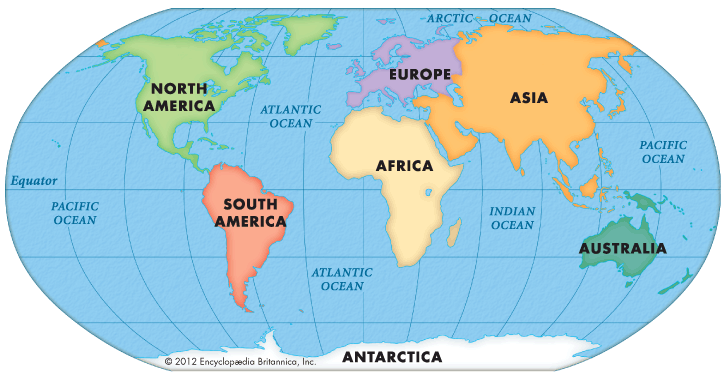
With my post yesterday on the first female scientists in Antarctica I wrapped up my project of featuring a woman from every continent. It was a project I enjoyed and learned a lot from. For me it was a great introduction into the world and the amazing women that inhabit it. It has been a great experience for me to see viewers from all over the world, I hope that continues and grows. Like I have stated before my eventual goal is to feature women that I know, and then eventually my dream is that readers will contact me about women they want to see featured. I would love to be able to highlight women across the world who have been nominated by people in their life. I know it may take awhile to actually get to that point, but it is where I want to end up. That means I need a wide audience and people willing to share what they read and share my mission. Thanks for joining me on this journey so far, and I hope you will stick with me as I start my next project.

Wednesday, April 1, 2015

First Female Scientists in Antarctica

It seems that many people agreed with Darlington when she stated that she did not think women belonged in Antarctica. It was long believed, by both sexes, that the female sex, the "weaker" of the two, would not be able to endure the rough Antarctic continent. Antarctica became, in many ways, the last, great "boys club". It was as if Antarctica was a giant tree house with an even bigger "NO GIRLS ALLOWED" hung up above it. Sure, the occasional "girl" got it, due to special circumstances such as being married to a member of an expedition, but they were not allowed in based on their own merits. In fact, the United States Navy REFUSED to transport women to Antarctica. Even if American scientists, who happened to be female, were able to somehow get to Antarctica, they would not be allowed to work on the ice, as the National Science Foundation (NSF) forbade women from working on the ice.

*Now, for the past several days I have been trying to figure out for sure who the first woman was to actually be allowed on Antarctica as a scientist. I keep finding articles and such that state who the first American female scientist, or Australian female scientist, etc. but not just the flat out first female scientist.*

It wasn't until the 1950's when Marie V. Klenova, a Russian marine geologist, was a part of an oceanographic team that was mapping uncharted portions of the continent that we see the first woman as an official part of scientific team in Antarctica. Russian women had sailed aboard whaling ships for years in the area, which made it a bit easier for her to break into the Antarctic scientific world. Klenova's work was part of the first atlas of Antarctica which the Soviet Union published.

Besides Marie Klenova, women did not do much work on the ice in the 40's and 50's as many countries, like the United States, did not allow women on the ice. In fact, it was not until the very end of the 1960's, after the Women's Liberation Movement, that we begin to see women actively participating in scientific endeavors on the Antarctic continent. The first woman to become a member of the United States Antarctic Research Program was Christine Muller-Schwarze, a psychologist with her Ph.D. from Utah State University. Alongside her scientist husband she studied the behavior of penguins on the Antarctic.

After Muller-Schwarze was able to break into the scene, the floodgates opened, and more women came to work on the frozen continent. Just a few weeks after the study of penguin behavior started, an all women team from Ohio State University arrived, headed by Lois Jones. Among the four women team was a 19 year old undergraduate student, Terry Tickhill Terrell, who joined the team after despairing at the idea of spending her entire college career inside of a chemistry lab.


The team from OSU, Kay Lindsay, Terry Tickhill Terrell, Lois Jones, and Eilenn McSaveney. 

Terry Terrell, who had never traveled more than 300 miles from her home, was now traveling to the bottom of the world, not quite knowing all of the barriers that had always stood between women and the place she was now headed to. There was a concern, or maybe a belief, that these women would not be able to make it down in the Antarctic. Their every move was watched, would they mess up? Would they come off weak, needy, inept? Knowing that they were under extreme scrutiny, the women kept to themselves, taking care of every issue they could on their own, and did what they came to do.


After awhile everyone came to accept that these women were there, and not only were they there, but they were doing their jobs quite well. Eventually the Navy decided to "cash in" on this novelty of women on their continent. Up to this point no woman had ever stepped foot on the South Pole. The Navy took the women down to the South Pole and organized the moment of the first woman to step foot on the very bottom of the Earth. The only problem was, who would be first? Rear Admiral D.F. Welch who was the commander of the naval forces in Antarctica at the time decided with Solomon like wisdom that the solution was for all six women to jump off the back of the plane at the same time, so they could all be the first woman to step foot on the South Pole. 


November 12, 1969 LtR Pam Young, Jean Pearson, Terry Tickhill Terell, Lois Jones, Eileen McSaveney, and Kay Lindsay.

Woman had arrived at the South Pole. It was a momentous occasion and was an event that was a long time coming. While women are still not in equal number as men on the Antarctic continent, they are at least now represented, and more so than they have been in past years. 


Saturday, March 28, 2015

Australia's First Female Acting Professor

So, with that great website that I found I had all sorts of wonderful options for my featured woman from Australia. I will admit that I did not go through every single woman on the site, but I now have a lot of options for future posts!


Born on January 22, 1875 Georgina Sweet would become Australia's first female acting professor. She was born in Brunswick Australia to English born parents, George and Fanny Sweet. Georgina's father, George ran a pottery and tiling business and was a hobbyist geologist. He had what sounds to be a quite impressive fossil collection that can now be found at the Museum of Victoria. Georgina acted as a scientist when she was young and her father encouraged her interest in science. As she got older she had his encouragement to go into science as a career.

Georgina first attended Parkville Ladies' College and then received her Bachelor's of Science from the University of Melbourne in 1896. In 1898 she won the University of Melbourne's McBain Scholarship and completed her Master's of Science from the university. For about eleven years from 1896-1907 she taught various secondary schools in the area. During this time she also filled several positions at the university, she was a demonstrator as well as a lecturer in Biology. Much of her research was done in the Biology department under Professor Baldwin Spencer. She also did research in the zoology department of the university. In 1904 Georgina Sweet completed her Doctorate degree at the University of Melbourne.

Initially Georgina's work in zoology focused on the Australian native animals. Eventually she switched and started pursuing the parasites that Australian stock are infested by. It was because of her research in this area that in 1911 she won the David Syne research prize. Her work was widely published and she eventually became known as Australia's foremost parasitologist.

In 1915, after a death in the biology school she became the second in command for that school at the University of Melbourne. It was the next year during the absence of one of the professors, whose place she took, that she became Australia's first acting associate professor, and in a science field none the less!!

While Georgina said that she never felt downtrodden or oppressed being a woman in a "man's" field, she was an active supporter and fighter for women's rights. In fact, on June 3 1935 she was appointed Officer of the Order of the British Empire, because of her services in the women's rights movement.


I love the fact that this woman pursued an interest of hers, that at that time was not something woman were encouraged to do. Not only did she pursue it, but she took it all the way to a Doctorate degree and taught at a university in that subject! From what I have read she had a true passion for it, and was able to spread that passion to others. She donated a large amount of money to her university, and today there is a fellowship in her name at the University of Melbourne. Georgina died January 1, 1946. 

Wednesday, March 11, 2015

Lou Xiaoying- Children Are Not Trash

A few years ago you may have read an internet article about a remarkable woman named Lou Xiaoying from China. If you enter her name into Google you will find pages upon pages of links about this woman, who probably never imagined that her name and actions would one day be flooded across the internet as people across the world shared her story. She was just a "normal, regular"
woman, who in the course of her everyday life as a trash collector did extraordinary things. Yes, this woman was a garbage lady, not a job that one usually thinks of when they think of someone "important" or "powerful", but this most definitely was both. I first came across Lou Xiaoying's story months ago though a Pinterest pin.I think it was the picture of her that really drew my attention.


It is a wonderful portrait of a woman to begin with, her face says so many different things. Then the small hand touching her face adds a whole other dimension to the picture. Once you know her story you see even more in the portrait, and it takes on a whole new meaning. 


Lou Xiaoying wonders the streets of Jinhua, in the eastern province of Zhejiang in China. She collects recyclable trash while she walks through theses streets, and that is how this woman made a living for most of her life. More than forty years ago, in 1972, while Lou Xiaoying was making her daily rounds she came across something a little bit different than the usual rubbish, a little baby girl who had been abandoned amongst the rubbish her parents must have seen her as. Lou Xiaoying could not leave this helpless baby out on her own, so the woman who made her living by collecting trash, took the baby home to raise. 

In a country with a one child per family policy that stretches back across four decades, abandoned infants are not a rare thing to find. After reaching a point of an average of four children per family that lead to a  famine crisis, China implemented a one child per family policy. This policy was in hopes of diminishing the future population of China and avoiding any future food shortages. The Telegraph has an article that covers the policy in more depth if your are interested. Due to this policy, many infants, especially baby girls, are either aborted, murdered, or abandoned, to keep families at the one child limit, that one child preferably being a boy.

This little girl that Lou Xiaoying rescued in 1972 did not wind up being the last child this remarkable woman would save. In fact, she went on to rescue over 30 children over the years. Some she and her husband kept and raised themselves, others they found homes for with friends and other family members. Lou Xiaoying and her husband, poor, "normal" people, did something so amazing, wonderful, and powerful, with the lives that they had, and through their, particularly her, power they were able to save the lives of over 30 innocent children.

If you are interested in a more in depth story, with wonderful pictures, The Daily Mail did a fantastic article.