Inspiring Women to Empower Others- My mission is to share the stories of women the world over, both in history and in present times, who are powerful. Not women in positions of power, but the everyday woman who has done something amazing. I hope to one day have readers nominate women in their own lives that can be featured on this blog.
Empowerment
Showing posts with label Continents. Show all posts
Thursday, April 2, 2015
Seven Continents Visited- Where Do I Go From Here?
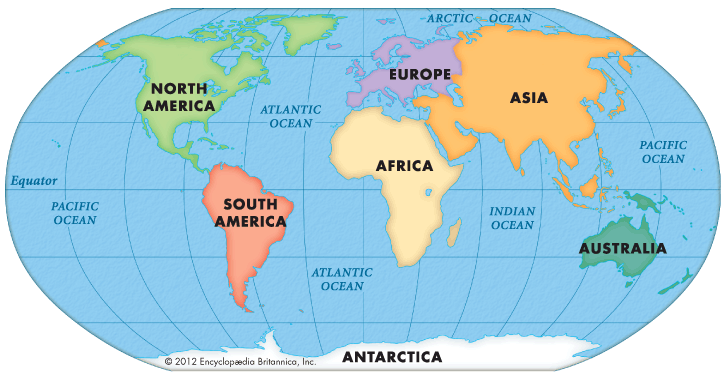
With my post yesterday on the first female scientists in Antarctica I wrapped up my project of featuring a woman from every continent. It was a project I enjoyed and learned a lot from. For me it was a great introduction into the world and the amazing women that inhabit it. It has been a great experience for me to see viewers from all over the world, I hope that continues and grows. Like I have stated before my eventual goal is to feature women that I know, and then eventually my dream is that readers will contact me about women they want to see featured. I would love to be able to highlight women across the world who have been nominated by people in their life. I know it may take awhile to actually get to that point, but it is where I want to end up. That means I need a wide audience and people willing to share what they read and share my mission. Thanks for joining me on this journey so far, and I hope you will stick with me as I start my next project.
Tuesday, March 31, 2015
First Women in Antarctica
The history of the discovery and exploration of Antarctica is a long one. From rumors of the continent, to the near discovery in the 1770's, to the first people to finally reach the South Pole in 1911, it stretches across centuries. While the first man stepped foot in 1911, the first woman would not arrive until more than two decades later, with Caroline Mikkelsen, the wife of a Norwegian whaling captain being the first woman to step foot on Antarctica in 1935. Her excursion to Antarctica was brief, but it was the first of its kind. It would be more than a decade until Antarctica would see another woman.
In 1947 we see the first women to winter in Antarctica, with the arrival of two women traveling with their husbands who were members of the Ronne Antarctic Research Expedition. Edith "Jackie" Ronne and Jennie Darlington, two women who originally planned on only journeying with their husbands as far as Valparasio, Chile, the last stop before reaching Antarctica, wound up at the last minute continuing with the Expedition to Antarctica. According to an obituary in the Washington Post, Ronne actually never planned on going with her husband at all, she traveled to Beaumont, Texas to see him off, but planned on returning home after that. The obituary states, "She packed little more than a good suit, a good dress, nylon stockings and high heels for the trip." However, her husband persuaded her to go with him, and she gave in, joining him for the journey, from Panama to Chile.
*These two pictures came from The Antarctic Book of Cooking and Cleaning
![]() |
| Caroline Mikkelsen |
![]() |
| Jennie and Edith |
![]() |
| Jackie making coffee in the hut. |
Once Jackie was convinced into going to Antarctica with her husband, she wanted another woman to go with her. Jennie Darlington, new wife of the chief pilot of the Expidition, Harry Darlington, was to be the second woman. Ronne was the first American woman to step foot onto Antarctica, and Ronne and Darlington became the first women ever to spend the winter in Antarctica. After they left Antarctica Darlington stated, "Taking everything into consideration, I do not think women belong in Antarctica." Ronne's opinion was, "I will never, never go back to the Antarctic." While Darlington stuck with her opinion, Ronne returned thrice more to the Antarctic in her future years.
These three women were the first women to ever step foot on Antarctica. Jackie Ronne was the first woman to assist the members of an Expedition, although she was not technically a member of the Expedition, she did serve as their recorder-historian.
Antarctica
So, I have been looking into women of Antarctica for the past several days, trying to figure out who to feature. It has been really interesting to do some reading about the women who are and have been in Antarctica, and the struggles that these women have gone through personally, as well as the struggles that every country has gone through in regards to Antarctica. I don't know about you, but usually in every day life I don't give a ton of thought to Antarctica. It is one of the seven continents, and usually that is about the extent of the thought that I give it in most circumstances.
However, after reading the articles and information I have found over the past few days, I think in the future when I think or hear about Antarctica it will be something much different that comes to mind. It has been enlightening and quite interesting reading about Antarctica, all the other continents I have been at least vaguely familiar with, knowing at least a small amount of history of each continent, some more than others. I keep stumbling upon more information about Antarctica, giving me a bit more knowledge each time. Today, for example, I just found this article that scientists just discovered fish and other life in a small wedge of seawater that is below a 740 meter thick sheet of ice.
Anyways, it has been an enjoyable process, both the post for Antarctica, as well as the posts for all of the other continents. I've learned quite a bit, and discovered many women that I have never heard about before. As I start my next project, which I will discuss after my post on women in Antarctica, I look forward to learning even more!
Friday, March 20, 2015
The First Afrikaner Feminist?
Ready or not, here she is! So the past several days I have been doing various Google searches trying to find just the right woman to highlight for the African continent. During these searches I found several amazing women, some who were actually from a country in Africa, some who were born elsewhere and moved there. Some of these women were dead, most were still alive. However, none of them were quite what I was looking for.
Sometime either yesterday or the day before I stumbled across a journal that had been put online from a few different woman who had been in the concentration camps during the Boer War. These were interesting, but there was not quite what I wanted. (Really, I do not think I could tell you exactly who I was searching for, or what I wanted, but I felt like I had not found the right individual yet.) After finding these journals I decided to do a bit of digging around to see if I could find a woman who lived somewhere around that time period that felt right.
Yesterday I came across a name and a short blip about a woman and it struck a nerve.
Sometime either yesterday or the day before I stumbled across a journal that had been put online from a few different woman who had been in the concentration camps during the Boer War. These were interesting, but there was not quite what I wanted. (Really, I do not think I could tell you exactly who I was searching for, or what I wanted, but I felt like I had not found the right individual yet.) After finding these journals I decided to do a bit of digging around to see if I could find a woman who lived somewhere around that time period that felt right.
![]() |
| Concentration Camps during war (1899-1902). |
Yesterday I came across a name and a short blip about a woman and it struck a nerve.
"A single Afrikaans woman raised her voice against this ideology. She was Marie du Toit, the sister of Prof. J.D. du Toit, popularly known as the Afrikaans poet Totius. In her book, Vrou en feminist, of Iets oor die vrouevraagstuk, published in 1921, she objected against the recommendation of a committee headed by her brother that, on biblical grounds, women should not be allowed to vote, neither in church nor in parliament."
I hadn't read much more than that, but I felt like here was a woman who was power. A woman who had stood up for something she believed in, against something she felt was wrong. The fact that she wrote a book going against something that her brother was backing, something that she objected to, was an idea that I just loved.
I started digging around online, trying to find more information about this woman. I did not have a ton to go on, so I just searched for her name. Apparently there is/was an actress with the same name. I tried different search tactics to try and find more about her.
Some back history to why Marie du Toit wrote her book and what was going on around her at that time. Several years prior to the publishing of her book, a monument, The Women's Monument was built in Bloemfontein. This monument was in recognition of the state and bravery of the Afrikaaner women. While this monument sounds like a great idea, no women were able to participate in the inauguration of monument, no women were interred there, and the suffering of the women was used to garner worldwide sympathy for the cause of the Boers. Actually, a man who allowed women to have a bake sale so that he could have funds to write a history of the woman, wrote the history to show that these women's souls "were too pure for politics, and that they had no intentions of becoming suffragettes like the women in Europe who worshipped the ideals of the French Revolution."
Basically, at this time, in this country, women were applauded for show submission and being subservient to their husbands. Since their souls were too "pure and fragile" for much else, they were expected to stay at home and take care of the family. (Now, I am not saying that no woman should ever stay home and take care of their family, I think that this is something that is actually a noble calling, and not something to be looked down upon.) Women were not allowed any power, political, religious, etc. and were seen as not strong enough, smart enough, etc. to hold any power or position.
Marie du Toit wrote her book in response and reaction to the decision made by the Reformed Church of South Africa in 1920, of which her brother had a part of, that stated women would not be permitted to vote about matters of the church. Apparently, this committed had found verses in the bible that they believed supported their decision to deny women the ability to vote in both state and church matters. Marie du Toit, however, debated that it was not Jesus nor nature that kept women held to private life, but rather men who did this. She, in fact, argued that it was a time when those suffering from poverty and oppression needed the insight and intelligence of women to help. In addition to this she believed that women should be allowed equal access to education and pay. She stated that the restrictions placed on women and the subservience expected of them was unnatural, and her interpretation of the Bible was that Jesus sought for women to be human beings, free akin to men. It was not the right of men to choose whether or not women could vote and be involved in public and political life. She asked Afrikaaner women to stand up and stand together to get their rights and to not feel unworthy. She wanted women to moved out of the private life in their home, and to move into a world where they could hold political power and make a difference in the world.
As far as Marie du Toit's life, little can be found on the internet. She was born in 1880 and remained an unmarried school teacher until her death at 51 in 1931. She did have tuberculosis, and I am assuming that this is what she died of. At the time of the publishing of her book she was little known, with apparently no supporters. She was a lone voice in a time and a country where her views were much before their time. Even today in a world of feminism and a struggle for equality between men and women, she is a unheard of individual.
Wednesday, March 11, 2015
Lou Xiaoying- Children Are Not Trash
A few years ago you may have read an internet article about a remarkable woman named Lou Xiaoying from China. If you enter her name into Google you will find pages upon pages of links about this woman, who probably never imagined that her name and actions would one day be flooded across the internet as people across the world shared her story. She was just a "normal, regular"
woman, who in the course of her everyday life as a trash collector did extraordinary things. Yes, this woman was a garbage lady, not a job that one usually thinks of when they think of someone "important" or "powerful", but this most definitely was both. I first came across Lou Xiaoying's story months ago though a Pinterest pin.I think it was the picture of her that really drew my attention.
It is a wonderful portrait of a woman to begin with, her face says so many different things. Then the small hand touching her face adds a whole other dimension to the picture. Once you know her story you see even more in the portrait, and it takes on a whole new meaning.
Lou Xiaoying wonders the streets of Jinhua, in the eastern province of Zhejiang in China. She collects recyclable trash while she walks through theses streets, and that is how this woman made a living for most of her life. More than forty years ago, in 1972, while Lou Xiaoying was making her daily rounds she came across something a little bit different than the usual rubbish, a little baby girl who had been abandoned amongst the rubbish her parents must have seen her as. Lou Xiaoying could not leave this helpless baby out on her own, so the woman who made her living by collecting trash, took the baby home to raise.
In a country with a one child per family policy that stretches back across four decades, abandoned infants are not a rare thing to find. After reaching a point of an average of four children per family that lead to a famine crisis, China implemented a one child per family policy. This policy was in hopes of diminishing the future population of China and avoiding any future food shortages. The Telegraph has an article that covers the policy in more depth if your are interested. Due to this policy, many infants, especially baby girls, are either aborted, murdered, or abandoned, to keep families at the one child limit, that one child preferably being a boy.
This little girl that Lou Xiaoying rescued in 1972 did not wind up being the last child this remarkable woman would save. In fact, she went on to rescue over 30 children over the years. Some she and her husband kept and raised themselves, others they found homes for with friends and other family members. Lou Xiaoying and her husband, poor, "normal" people, did something so amazing, wonderful, and powerful, with the lives that they had, and through their, particularly her, power they were able to save the lives of over 30 innocent children.
If you are interested in a more in depth story, with wonderful pictures, The Daily Mail did a fantastic article.
Tuesday, February 24, 2015
Irena Sendler
There are certain events and times in history that almost everyone knows about. Ever heard of little events known as World War I and World War II? What about the Holocaust? In addition to these events most people recognize the names of individuals like Joseph Stalin, Benito Mussolini, and Adolf Hitler. Some may be more familiar with one of the other of these men, but it is more than likely that you have at least HEARD these names before. As a former History major in college and an avid history fan myself, I am more than familiar with these names. While studying these individuals was fascinating in a terrible way, I actually enjoyed learning about the little known people throughout history, both your average every day Jane and Joe who represented the people as well as the unsung heroes throughout history.
Irena Sendler. Does the name ring a bell? No, not Irene Adler from Sherlock Holmes, who due to the most recent adaptions of the movie and BBC series has become just about as infamous as Sherlock himself. Irena Sendler was a name that I had not heard about either until I came across this "pin" on Pinterest, a year or more ago.
I instantly pinned the pin and would occasionally think of this little known woman who had done such an amazing thing in her life. Here was a "real women with power". I have done a bit more research on Irena, and I believe that a few of the facts on this pin are incorrect, as far as her occupation, etc. These little inaccuracies do not make her story any less amazing or her any less powerful. The story of who she was "rediscovered" is in and of itself a great process.
Life in a Jar is the official website of a project that has helped share Irena Sendler's life with the world and in so many ways have changed the lives of thousands more, even after her life has ended. 16 years ago three high schools students from Kansas were helped by their teacher to undertake a project that would last the entire year. The website explains it as a, "National History Day project which would, among other things, extend the boundaries of the classroom to families in the community, contribute to history learning, teach respect and tolerance, and meet our classroom motto, "He who changes one person, changes the world entire.'" After seeing a cut out of a News and World report from five years prior that briefly mentioned Irena, the young women set out on a journey of discovery of Irena.
Irena Sendler. Does the name ring a bell? No, not Irene Adler from Sherlock Holmes, who due to the most recent adaptions of the movie and BBC series has become just about as infamous as Sherlock himself. Irena Sendler was a name that I had not heard about either until I came across this "pin" on Pinterest, a year or more ago.
I instantly pinned the pin and would occasionally think of this little known woman who had done such an amazing thing in her life. Here was a "real women with power". I have done a bit more research on Irena, and I believe that a few of the facts on this pin are incorrect, as far as her occupation, etc. These little inaccuracies do not make her story any less amazing or her any less powerful. The story of who she was "rediscovered" is in and of itself a great process.
Life in a Jar is the official website of a project that has helped share Irena Sendler's life with the world and in so many ways have changed the lives of thousands more, even after her life has ended. 16 years ago three high schools students from Kansas were helped by their teacher to undertake a project that would last the entire year. The website explains it as a, "National History Day project which would, among other things, extend the boundaries of the classroom to families in the community, contribute to history learning, teach respect and tolerance, and meet our classroom motto, "He who changes one person, changes the world entire.'" After seeing a cut out of a News and World report from five years prior that briefly mentioned Irena, the young women set out on a journey of discovery of Irena.
Among other things, they discovered that Irena was a young Protestant or Catholic (I believe) social worker during the Nazi regime. She was able to gain access to the Warsaw Ghetto, where Jewish families lived and many ultimately were sent to the death camps, and essentially talked these desperate Jewish families into given up their children in hopes of their survival. She then sneaked these children out the Ghetto, and was able to adopt them into families or hide them in orphanages and convents in Poland. She and the people she worked with kept a coded list of the real names of the children, as their names had to be changed to protect their Jewish identity, and hoped that one day they would be able to find these children and reveal to them their heritage that had to be hidden for their safety.
After several years Irena was captured and by the Nazis and beaten to such an extent that both of her legs were broken. Eventually the Polish underground was able to bribe a guard and get her to safety and into hiding.
After WWII Irena Sendler was branded a fascist by the Communists and for many years her story was mostly hidden. It is amazing to be that this woman, along with several others rescued 2,500 children during such a horrible period, and yet hers is not a name that is known. I have always felt that while there is so much darkness and ugliness in the world and we should be aware of it, there is just as much, if not more light, but it is not those things we celebrate.
My summary about Irena Sendler was very brief, and there is much more information out there. I strongly urge you to go to Life In A Jar which is about the project that the young women who "rediscovered" Irena have continued working on. Her story was turned into a play, there is now a book, as well as a movie. Almost two dozen colleges and universities are now using her letters and other documents as part of the curriculum. "He who changes one person, changes the world entire."
Subscribe to:
Posts (Atom)


.jpg)


