Inspiring Women to Empower Others- My mission is to share the stories of women the world over, both in history and in present times, who are powerful. Not women in positions of power, but the everyday woman who has done something amazing. I hope to one day have readers nominate women in their own lives that can be featured on this blog.
Empowerment
Showing posts with label Antarctica. Show all posts
Thursday, April 2, 2015
Seven Continents Visited- Where Do I Go From Here?
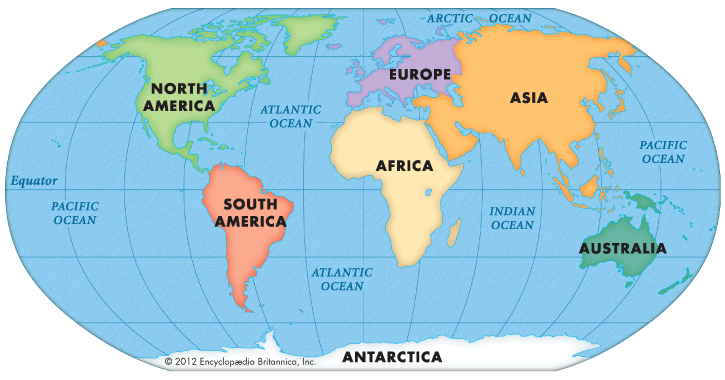
With my post yesterday on the first female scientists in Antarctica I wrapped up my project of featuring a woman from every continent. It was a project I enjoyed and learned a lot from. For me it was a great introduction into the world and the amazing women that inhabit it. It has been a great experience for me to see viewers from all over the world, I hope that continues and grows. Like I have stated before my eventual goal is to feature women that I know, and then eventually my dream is that readers will contact me about women they want to see featured. I would love to be able to highlight women across the world who have been nominated by people in their life. I know it may take awhile to actually get to that point, but it is where I want to end up. That means I need a wide audience and people willing to share what they read and share my mission. Thanks for joining me on this journey so far, and I hope you will stick with me as I start my next project.
Wednesday, April 1, 2015
First Female Scientists in Antarctica
It seems that many people agreed with Darlington when she stated that she did not think women belonged in Antarctica. It was long believed, by both sexes, that the female sex, the "weaker" of the two, would not be able to endure the rough Antarctic continent. Antarctica became, in many ways, the last, great "boys club". It was as if Antarctica was a giant tree house with an even bigger "NO GIRLS ALLOWED" hung up above it. Sure, the occasional "girl" got it, due to special circumstances such as being married to a member of an expedition, but they were not allowed in based on their own merits. In fact, the United States Navy REFUSED to transport women to Antarctica. Even if American scientists, who happened to be female, were able to somehow get to Antarctica, they would not be allowed to work on the ice, as the National Science Foundation (NSF) forbade women from working on the ice.
*Now, for the past several days I have been trying to figure out for sure who the first woman was to actually be allowed on Antarctica as a scientist. I keep finding articles and such that state who the first American female scientist, or Australian female scientist, etc. but not just the flat out first female scientist.*
It wasn't until the 1950's when Marie V. Klenova, a Russian marine geologist, was a part of an oceanographic team that was mapping uncharted portions of the continent that we see the first woman as an official part of scientific team in Antarctica. Russian women had sailed aboard whaling ships for years in the area, which made it a bit easier for her to break into the Antarctic scientific world. Klenova's work was part of the first atlas of Antarctica which the Soviet Union published.
Besides Marie Klenova, women did not do much work on the ice in the 40's and 50's as many countries, like the United States, did not allow women on the ice. In fact, it was not until the very end of the 1960's, after the Women's Liberation Movement, that we begin to see women actively participating in scientific endeavors on the Antarctic continent. The first woman to become a member of the United States Antarctic Research Program was Christine Muller-Schwarze, a psychologist with her Ph.D. from Utah State University. Alongside her scientist husband she studied the behavior of penguins on the Antarctic.
After Muller-Schwarze was able to break into the scene, the floodgates opened, and more women came to work on the frozen continent. Just a few weeks after the study of penguin behavior started, an all women team from Ohio State University arrived, headed by Lois Jones. Among the four women team was a 19 year old undergraduate student, Terry Tickhill Terrell, who joined the team after despairing at the idea of spending her entire college career inside of a chemistry lab.
Terry Terrell, who had never traveled more than 300 miles from her home, was now traveling to the bottom of the world, not quite knowing all of the barriers that had always stood between women and the place she was now headed to. There was a concern, or maybe a belief, that these women would not be able to make it down in the Antarctic. Their every move was watched, would they mess up? Would they come off weak, needy, inept? Knowing that they were under extreme scrutiny, the women kept to themselves, taking care of every issue they could on their own, and did what they came to do.
*Now, for the past several days I have been trying to figure out for sure who the first woman was to actually be allowed on Antarctica as a scientist. I keep finding articles and such that state who the first American female scientist, or Australian female scientist, etc. but not just the flat out first female scientist.*
It wasn't until the 1950's when Marie V. Klenova, a Russian marine geologist, was a part of an oceanographic team that was mapping uncharted portions of the continent that we see the first woman as an official part of scientific team in Antarctica. Russian women had sailed aboard whaling ships for years in the area, which made it a bit easier for her to break into the Antarctic scientific world. Klenova's work was part of the first atlas of Antarctica which the Soviet Union published.
Besides Marie Klenova, women did not do much work on the ice in the 40's and 50's as many countries, like the United States, did not allow women on the ice. In fact, it was not until the very end of the 1960's, after the Women's Liberation Movement, that we begin to see women actively participating in scientific endeavors on the Antarctic continent. The first woman to become a member of the United States Antarctic Research Program was Christine Muller-Schwarze, a psychologist with her Ph.D. from Utah State University. Alongside her scientist husband she studied the behavior of penguins on the Antarctic.
After Muller-Schwarze was able to break into the scene, the floodgates opened, and more women came to work on the frozen continent. Just a few weeks after the study of penguin behavior started, an all women team from Ohio State University arrived, headed by Lois Jones. Among the four women team was a 19 year old undergraduate student, Terry Tickhill Terrell, who joined the team after despairing at the idea of spending her entire college career inside of a chemistry lab.
![]() The team from OSU, Kay Lindsay, Terry Tickhill Terrell, Lois Jones, and Eilenn McSaveney. |
After awhile everyone came to accept that these women were there, and not only were they there, but they were doing their jobs quite well. Eventually the Navy decided to "cash in" on this novelty of women on their continent. Up to this point no woman had ever stepped foot on the South Pole. The Navy took the women down to the South Pole and organized the moment of the first woman to step foot on the very bottom of the Earth. The only problem was, who would be first? Rear Admiral D.F. Welch who was the commander of the naval forces in Antarctica at the time decided with Solomon like wisdom that the solution was for all six women to jump off the back of the plane at the same time, so they could all be the first woman to step foot on the South Pole.
Tuesday, March 31, 2015
First Women in Antarctica
The history of the discovery and exploration of Antarctica is a long one. From rumors of the continent, to the near discovery in the 1770's, to the first people to finally reach the South Pole in 1911, it stretches across centuries. While the first man stepped foot in 1911, the first woman would not arrive until more than two decades later, with Caroline Mikkelsen, the wife of a Norwegian whaling captain being the first woman to step foot on Antarctica in 1935. Her excursion to Antarctica was brief, but it was the first of its kind. It would be more than a decade until Antarctica would see another woman.
In 1947 we see the first women to winter in Antarctica, with the arrival of two women traveling with their husbands who were members of the Ronne Antarctic Research Expedition. Edith "Jackie" Ronne and Jennie Darlington, two women who originally planned on only journeying with their husbands as far as Valparasio, Chile, the last stop before reaching Antarctica, wound up at the last minute continuing with the Expedition to Antarctica. According to an obituary in the Washington Post, Ronne actually never planned on going with her husband at all, she traveled to Beaumont, Texas to see him off, but planned on returning home after that. The obituary states, "She packed little more than a good suit, a good dress, nylon stockings and high heels for the trip." However, her husband persuaded her to go with him, and she gave in, joining him for the journey, from Panama to Chile.
*These two pictures came from The Antarctic Book of Cooking and Cleaning
![]() |
| Caroline Mikkelsen |
![]() |
| Jennie and Edith |
![]() |
| Jackie making coffee in the hut. |
Once Jackie was convinced into going to Antarctica with her husband, she wanted another woman to go with her. Jennie Darlington, new wife of the chief pilot of the Expidition, Harry Darlington, was to be the second woman. Ronne was the first American woman to step foot onto Antarctica, and Ronne and Darlington became the first women ever to spend the winter in Antarctica. After they left Antarctica Darlington stated, "Taking everything into consideration, I do not think women belong in Antarctica." Ronne's opinion was, "I will never, never go back to the Antarctic." While Darlington stuck with her opinion, Ronne returned thrice more to the Antarctic in her future years.
These three women were the first women to ever step foot on Antarctica. Jackie Ronne was the first woman to assist the members of an Expedition, although she was not technically a member of the Expedition, she did serve as their recorder-historian.
Antarctica
So, I have been looking into women of Antarctica for the past several days, trying to figure out who to feature. It has been really interesting to do some reading about the women who are and have been in Antarctica, and the struggles that these women have gone through personally, as well as the struggles that every country has gone through in regards to Antarctica. I don't know about you, but usually in every day life I don't give a ton of thought to Antarctica. It is one of the seven continents, and usually that is about the extent of the thought that I give it in most circumstances.
However, after reading the articles and information I have found over the past few days, I think in the future when I think or hear about Antarctica it will be something much different that comes to mind. It has been enlightening and quite interesting reading about Antarctica, all the other continents I have been at least vaguely familiar with, knowing at least a small amount of history of each continent, some more than others. I keep stumbling upon more information about Antarctica, giving me a bit more knowledge each time. Today, for example, I just found this article that scientists just discovered fish and other life in a small wedge of seawater that is below a 740 meter thick sheet of ice.
Anyways, it has been an enjoyable process, both the post for Antarctica, as well as the posts for all of the other continents. I've learned quite a bit, and discovered many women that I have never heard about before. As I start my next project, which I will discuss after my post on women in Antarctica, I look forward to learning even more!
Subscribe to:
Posts (Atom)